7 Red Flags to Check Before Accepting a New B2B Buyer
Every new buyer can bring an opportunity for business growth. A large enquiry, repeat-order proposal, or request for long-term supply may look promising, especially for businesses trying to increase sales and expand into new markets.
However, in B2B trade, every new buyer can also introduce financial risk. A customer may appear genuine at the beginning of a transaction but later delay payment, dispute an invoice, change agreed terms, or create unnecessary pressure on your working capital.
This is why B2B buyer verification should be an important part of your customer onboarding and credit-approval process.
Buyer verification does not mean assuming that every new customer is risky. It simply means checking enough reliable business information before committing significant stock, time, resources, or unsecured credit.
A structured B2B buyer verification process can help you identify potential warning signs early and make better-informed commercial decisions.
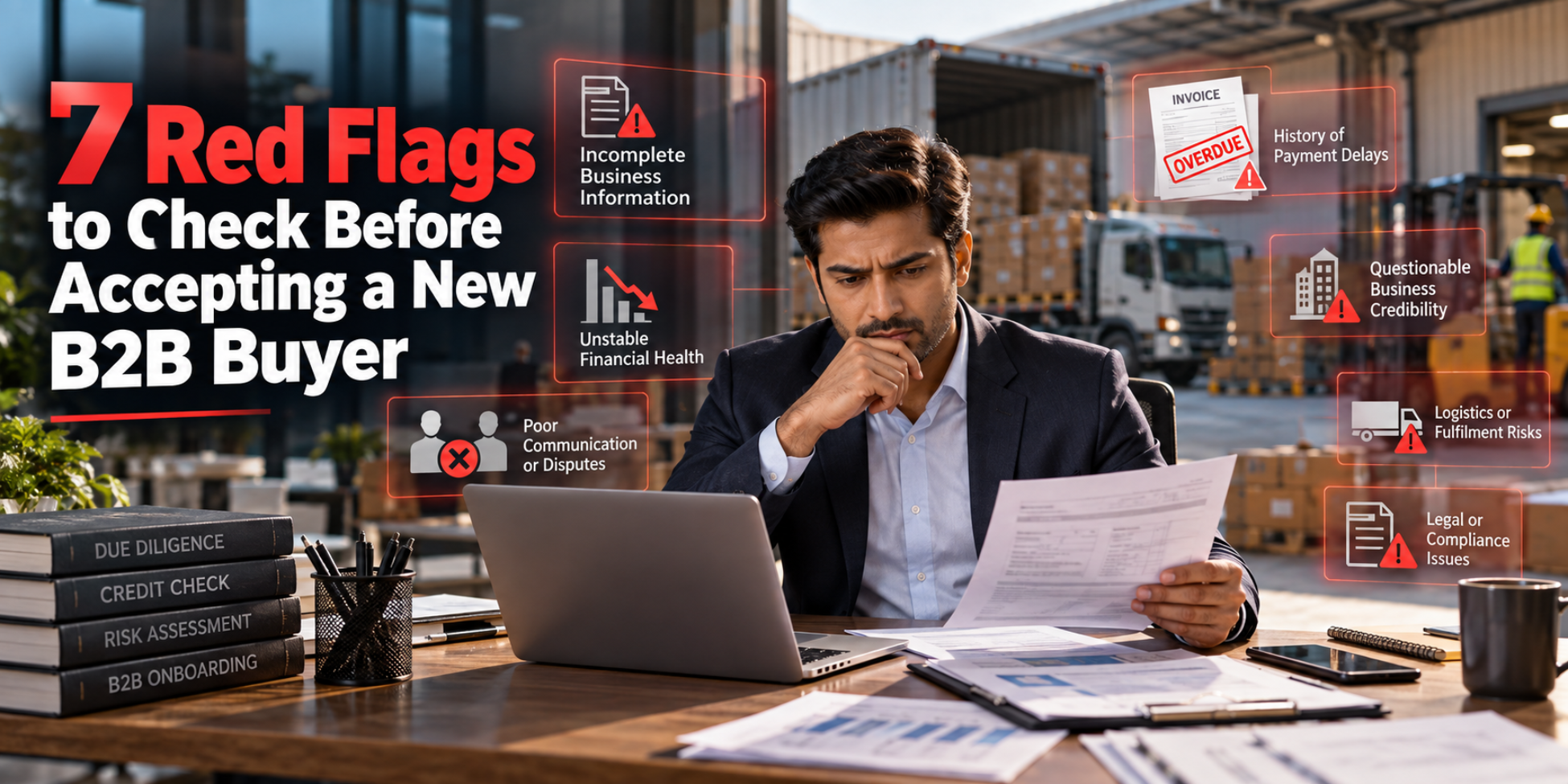
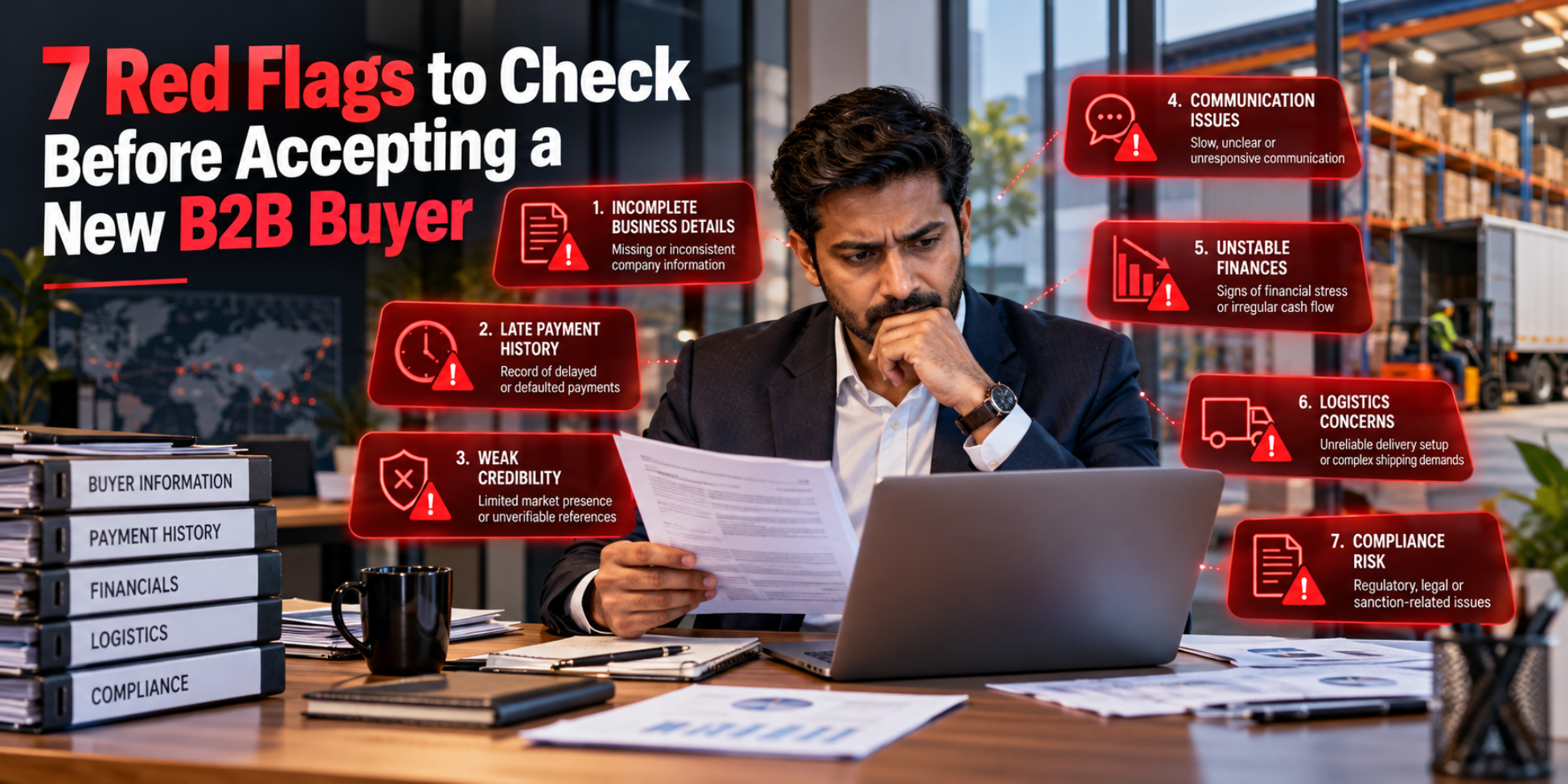
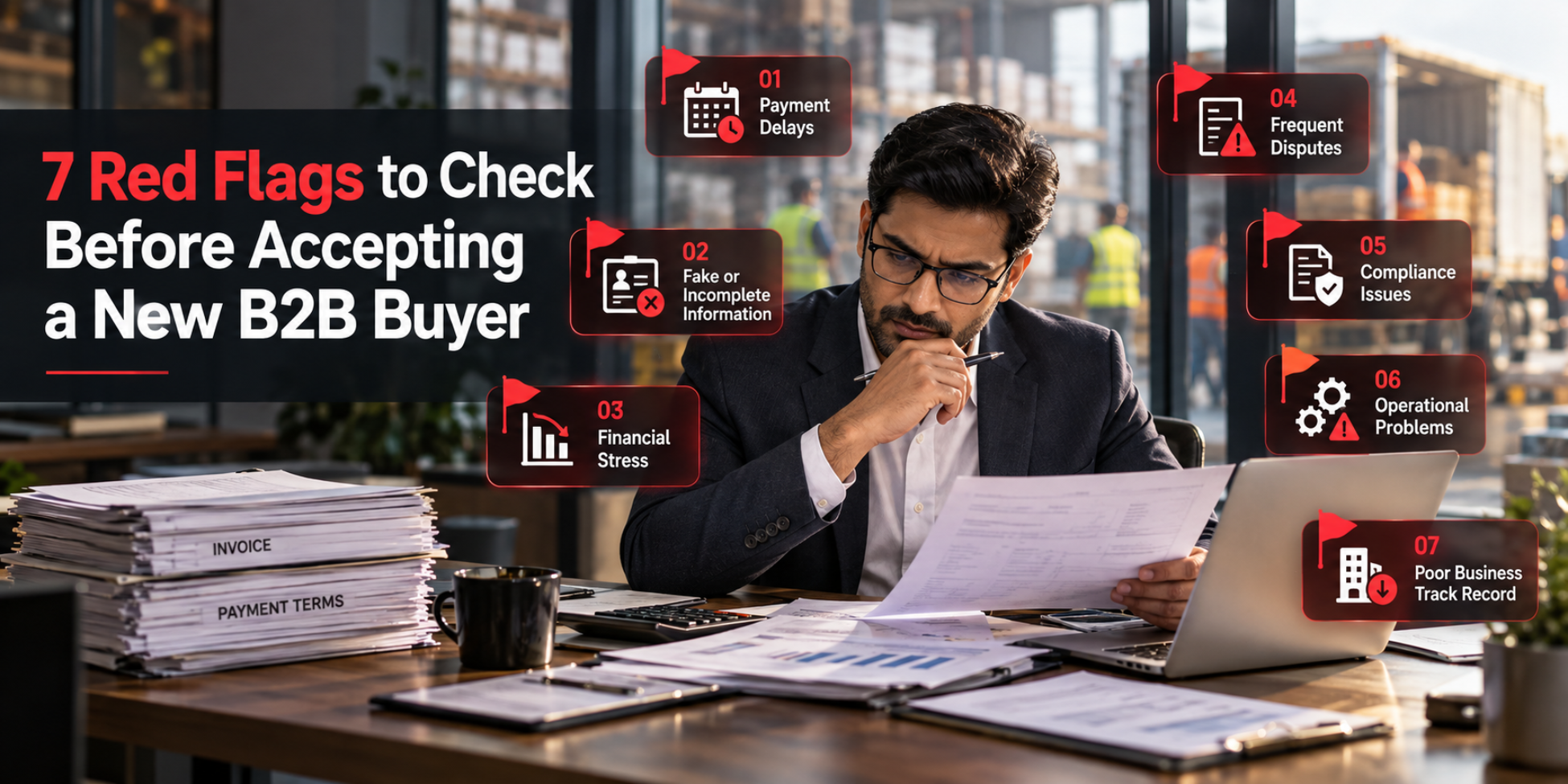
Here are seven important red flags to check before accepting a new B2B buyer.
1. Incomplete or Inconsistent Business Information
One of the first warning signs to look for is incomplete, unclear, or inconsistent information about the buyer’s business.
A legitimate business should normally be able to provide basic information about its legal and commercial identity.
During B2B buyer verification, consider checking details such as:
- Legal business name
- Trade name
- GSTIN, where applicable
- Registered business address
- Operating or delivery address
- Official phone number
- Business email address
- Nature of business
- Authorized contact person
- Purchase order details
Compare these details across the documents and communication channels available to you.
For example, if the name appearing on the purchase order is different from the GST registration, or the delivery address has no clear connection with the buyer’s business, it may be worth asking for clarification.
Small differences do not automatically mean there is a problem. Businesses may have warehouses, branch offices, corporate offices, or different trade names. The real concern is when the buyer cannot reasonably explain those differences.
2. Pressure to Offer Credit Immediately
Another common red flag is when a new customer aggressively pushes for a large credit limit before establishing any payment history with your business.
The buyer may ask for 30-day, 60-day, or even 90-day credit on the first transaction.
Credit terms are a normal part of B2B trade. The concern is not simply that the buyer is asking for credit. The concern is whether the amount and duration of the requested credit can be justified by the available information.
Good B2B buyer verification can help you decide whether the requested exposure is commercially reasonable.
For a new customer, businesses may consider safer approaches such as:
- Partial advance payment
- Shorter payment terms
- Smaller initial order value
- Controlled credit limits
- Credit review after successful transactions
One mistake businesses sometimes make is approving a large credit limit simply because the sales opportunity looks attractive.
Revenue is only valuable when the business successfully collects the payment.
3. Unclear Payment History or Weak Trade References
Before extending substantial credit, it is useful to understand how the buyer has handled previous commercial relationships.
Where appropriate, you may ask the buyer for trade references or examine available trade-experience information.
During B2B buyer verification, watch for patterns such as:
- Repeated delayed payments
- Frequent requests for payment extensions
- Unresolved supplier disputes
- Inconsistent payment commitments
- Communication stopping after invoices are raised
- Repeated deductions from agreed invoice values
One delayed payment does not necessarily mean the buyer is unreliable. Even established businesses can experience temporary cash-flow issues or operational disruptions.
The more useful question is whether there is a recurring pattern.
4. Sudden Large Orders From a New Buyer
A large order from a new buyer can look like excellent business. However, it can also expose your company to a much larger financial risk before trust has been established.
Imagine your average first-time order is worth ₹50,000, but a completely new buyer suddenly requests products worth ₹10 lakh and asks for full credit.
This does not automatically mean there is anything wrong with the buyer. The company may genuinely be expanding, executing a large project, or fulfilling a major customer contract.
However, a significantly larger transaction makes B2B buyer verification even more important.
Before approving such an order, consider confirming:
- Who is placing the order
- Whether the purchase order is genuine
- Whether the buyer’s business activity supports the order
- Whether the delivery location is legitimate
- Whether the requested credit limit is appropriate
- Whether part of the payment can be collected in advance
Your sales team may naturally want to close a high-value order quickly, but internal risk checks should not be ignored because of sales pressure.
A large sale can quickly become a working-capital problem if the payment remains outstanding for several months.
5. Frequent Changes in Contact Person, Address or Business Details
Businesses naturally change over time. Employees leave, offices relocate, warehouses change, and ownership structures evolve.
However, frequent or unexplained changes can be a red flag during B2B buyer verification.
Examples can include:
- A new bank account suddenly being shared
- Frequent changes in billing address
- Different contact persons providing conflicting instructions
- Purchase orders coming from unrelated email addresses
- Delivery requested at an unfamiliar location
- Sudden changes in company ownership or management
Whenever an important business detail changes, particularly bank or delivery information, it is sensible to confirm it through a reliable communication channel.
For high-value transactions, businesses may also reconfirm account details, authorized contacts, and delivery instructions with known representatives.
6. Poor Communication and Avoidance of Written Commitments
Communication quality can reveal a great deal about a commercial relationship.
A professional buyer should normally be willing to document important transaction terms clearly.
These can include:
- Product specifications
- Quantity
- Pricing
- Delivery schedule
- Payment terms
- Credit period
- Return conditions
- Inspection terms
- Transportation responsibilities
- Product acceptance criteria
If the buyer repeatedly avoids written confirmations and wants all important terms handled only through phone calls or informal discussions, the transaction can become harder to manage.
Effective B2B buyer verification should therefore include checking whether commercial expectations are clearly recorded before goods are supplied.
Purchase orders, invoices, emails, contracts, delivery acknowledgements, and other written records can help reduce misunderstandings later.
7. Negative Trade Patterns, Complaints or Repeated Disputes
The final red flag is a pattern of negative trading experiences associated with the buyer.
Depending on the information legally and legitimately available to your business, B2B buyer verification may include reviewing:
- Trade references
- Supplier feedback
- Available trade-experience information
- Public business information
- Internal records from previous transactions
- Relevant insolvency or court information
- Repeated commercial disputes
The objective should not be to reject a customer simply because one complaint exists.
Commercial disputes may arise for legitimate reasons, including product damage, quality concerns, incorrect quantity, transportation problems, or documentation issues.
Instead, pay attention to repeated and similar patterns.
For example, if multiple independent suppliers report similar experiences involving delayed payments, unexplained deductions, or communication stopping after delivery, the pattern deserves closer examination.
What Should You Check Before Approving a New B2B Buyer?
A structured verification process does not have to be complicated. Even a simple checklist can improve your credit-control process.
- Verify the buyer’s business identity.
- Check legal and trade names.
- Confirm GST registration details where applicable.
- Review the registered and operating address.
- Verify official contact information.
- Understand the nature of the buyer’s business.
- Check trade references where appropriate.
- Review available trade and payment experiences.
- Confirm purchase order authenticity.
- Evaluate the requested credit amount.
- Consider whether advance payment is appropriate.
- Document payment and delivery terms.
- Maintain delivery and acceptance proof.
- Obtain internal approval for unusually high credit exposure.
Using a defined B2B buyer verification checklist helps your team make decisions based on information rather than only on the excitement of securing a new order.
B2B Buyer Verification Should Be an Ongoing Process
A common mistake is verifying a buyer only before the first order.
Business conditions change. A customer who paid regularly for several years may later experience financial pressure, operational disruption, loss of a major customer, management changes, or other commercial difficulties.
For this reason, B2B buyer verification should be treated as an ongoing risk-management process.
Businesses can periodically review:
- Outstanding invoices
- Average payment delay
- Credit utilization
- Sudden increases in order value
- Changes in communication behavior
- Dispute frequency
- Changes in business details
- Payment promises and actual payment behavior
Long-term customers may not need to go through the entire onboarding process repeatedly, but significant changes in their trading behavior should trigger additional review.
How B2B Buyer Verification Helps Protect Working Capital
Payment delays affect much more than revenue.
When customer invoices remain unpaid, a supplier’s working capital becomes locked. The business may still need to pay employees, vendors, transporters, taxes, rent, and operating expenses even though it has not received payment from the buyer.
A practical B2B buyer verification process can therefore help businesses decide:
- Whether credit should be offered
- How much credit should be approved
- How long the credit period should be
- Whether advance payment should be required
- Whether additional internal approval is necessary
Buyer verification cannot eliminate all business risks. No verification process can guarantee that every invoice will always be paid on time.
The purpose is to make risk more visible and manageable before it becomes a serious financial problem.
Final Thoughts
Every new B2B buyer represents both opportunity and responsibility.
Businesses should not automatically reject new customers because they do not have an existing trading history. At the same time, suppliers should avoid extending significant unsecured credit without first understanding who they are trading with.
A structured B2B buyer verification process can help you confirm important business details, detect potential warning signs, establish appropriate payment terms, and make more informed credit decisions.
Pay attention to incomplete information, pressure for excessive credit, unclear payment history, unusually large first orders, frequent changes in business details, poor documentation, and repeated trade disputes.
The objective is not to eliminate every possible risk. It is to trade with better information, stronger documentation, and appropriate credit controls.
In B2B trade, spending a little more time on B2B buyer verification before approving a transaction can potentially save months of payment follow-ups later.

Pingback: Customer Credit Risk: 5 Powerful Checks for Businesses | TEI